> ## Documentation Index
> Fetch the complete documentation index at: https://docs.verisoul.ai/llms.txt
> Use this file to discover all available pages before exploring further.
# Multi-Accounting
> Understanding and preventing multi-accounting fraud with Verisoul
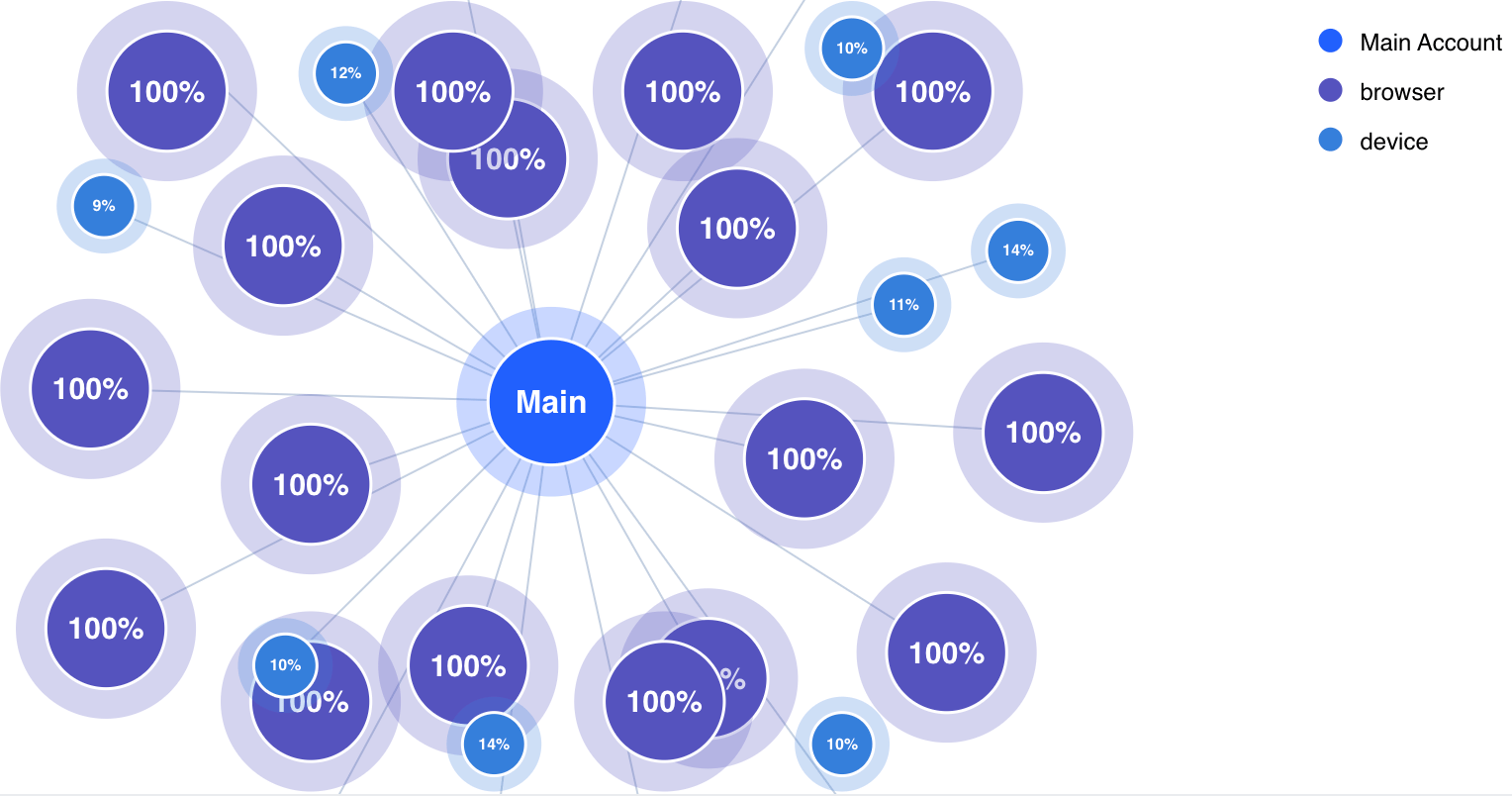
Multi-accounting (also known as duplicate accounts) occurs when a single person creates and operates multiple accounts on your platform. This is a common fraud pattern that can lead to significant losses through promotional abuse, collusion, and other fraudulent activities.
## Why Multi-Accounting Is a Problem
Claiming welcome bonuses, referral rewards, or discounts multiple times
Unfair advantages in gaming, gambling, or marketplace platforms
Creating artificial engagement or fake reviews
Consuming limited resources or free trials repeatedly
## Components of Verisoul's Multi-Accounting Detection
Verisoul's multi-accounting detection system consists of several interconnected components that work together to provide an accurate risk assessment.
Verisoul identifies three primary match types between accounts:
The only deterministic match type with zero false positives
Always results in a score of 1 (highest confidence)
Based on browser-specific identifiers
Based on hardware and software characteristics
Includes device fingerprinting techniques
Probabilistic with varying confidence levels
Analysis of network patterns and characteristics
Includes IP address analysis and packet inspection
Probabilistic with varying confidence levels
Analyzes string similarity of normalized email addresses
Strips special characters like dots (.) and plus (+) signs
Identifies users creating variations of the same email
Each potential connection between two accounts receives a score (0-1) based on several factors:
Match type strength: Browser matches (score 1) > Device matches > Network matches
Number of sessions matched: More matching sessions increase confidence
Fingerprint uniqueness:
- Globally unique fingerprints provide higher confidence
- Common fingerprints (seen frequently across many users) provide lower confidence
Time between sessions:
- Sessions close together in time provide stronger signals
- Sessions weeks apart provide weaker signals
Two accounts sharing a unique device fingerprint across multiple sessions within minutes would receive a high account-to-account score, while two accounts sharing only a common network characteristic weeks apart would receive a low score.
The `multiple_accounts` field is the culmination of all account-to-account scores, representing the overall likelihood that an account is part of a multi-accounting scheme:
Range: 0 (no risk) to 1 (highest risk)
Primary risk indicator: This is the most important field for assessing multi-accounting risk
This probability is calculated by:
- Evaluating all account-to-account scores
- Considering the number of linked accounts
- Applying the accounts linked threshold configuration
Default value: 1 (a single perfect match results in probability of 1)
Custom values: Can be adjusted based on your business needs
Example: Setting to 3 allows users to have up to 3 accounts before triggering high probability scores
Purpose: Helps reduce false positives while still preventing scaled fraud
Contact the Verisoul team to configure the accounts\_linked\_threshold for your specific use case.
## Accounts Linked API Response
When you query the Verisoul API for accounts linked to a specific account, you'll receive data about potential multi-accounting:
```json theme={null}
{
"accounts_linked": [
{
"account_id": "account_1",
"score": 1, // Certain match
"match_type": [
"browser",
"network",
"device"
],
"email": "account_1@example.com",
"lists": [
"allow"
],
"metadata": {}
},
{
"account_id": "account_2",
"score": 0.3, // Low confidence match
"match_type": [
"network"
],
"email": "account_2@example.com",
"lists": [
"block"
],
"metadata": {}
}
]
}
```
## How Scores Roll Up Into Multi-Accounting Probability
The relationship between account-to-account scores and multiple accounts score:
1. Strong matches dominate: A single strong match (especially a browser match with score 1) can result in a high probability
2. Quantity vs. quality: Many weak matches may not significantly increase probability
3. Threshold application: The accounts\_linked\_threshold determines how many strong matches are needed for a high probability
### Risk Examples
An account with one perfect browser match (score 1) would likely have a high `multiple_accounts` score (near 1)
An account with several medium-strength device matches (scores 0.4-0.6) might have a moderate `multiple_accounts` score
An account with many low-strength network matches (scores 0.1-0.3) would likely have a low `multiple_accounts` score
## Why Fingerprints Aren't Returned
1. Fraud prevention effectiveness: Raw fingerprints are easily changed by fraudsters who modify device attributes
2. Stability issues: Fingerprints aren't exact, can have false positives, and aren't always stable
3. Complexity: Resolving and actioning a graph database is complex
4. Automation: Verisoul automates this process while remaining flexible enough to tune to your ecosystem
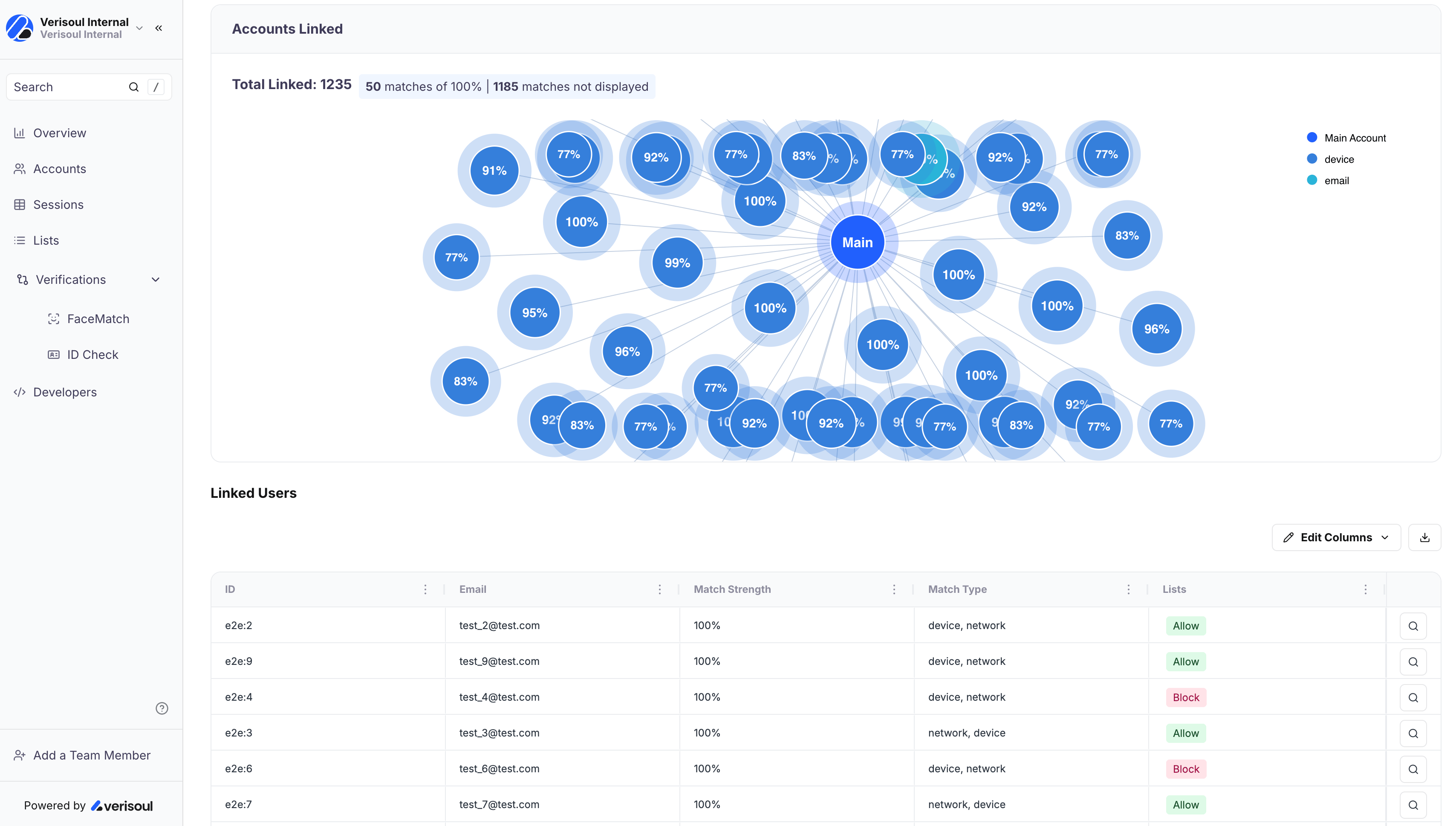
## Viewing Account Linkages
The graph of linked accounts is viewable in the Verisoul dashboard and can be retrieved at any time via the accounts linked API. This provides a visual representation of potential multi-accounting clusters.